Low Phase Noise
We Have the Best GPS-Derived Low-Phase-Noise Specs in the World
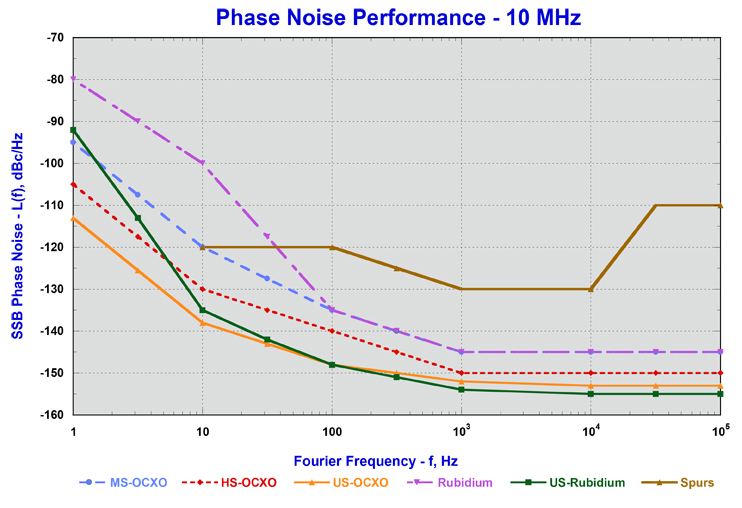
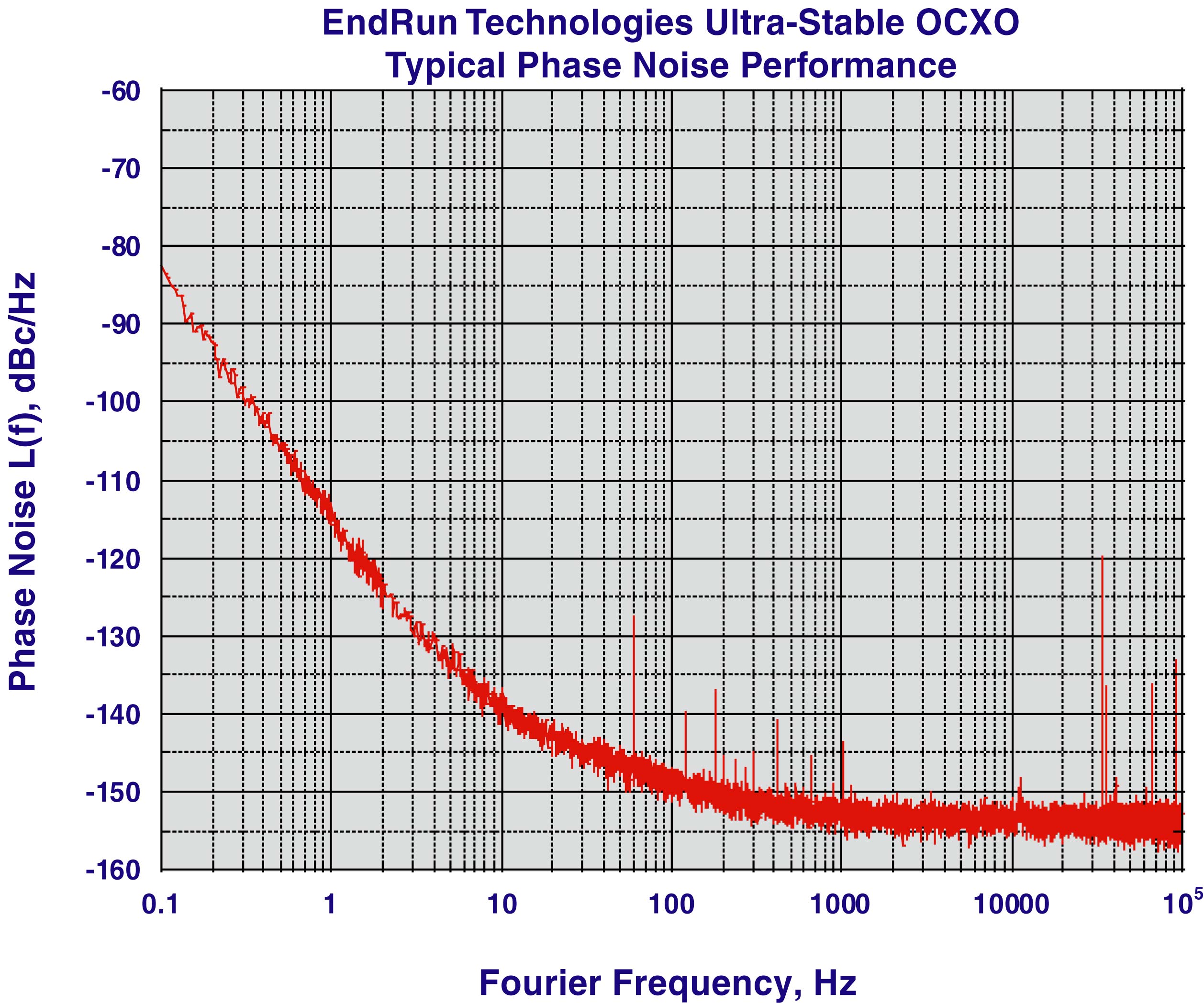
The low-phase-noise specifications of the 5 MHz and 10 MHz sine wave outputs are dependent on the installed oscillator. We design and manufacture our own oven-controlled crystal oscillators (OCXO) because we cannot find the quality or performance we need elsewhere. While Rubidium oscillators are excellent for stringent holdover requirements, they exhibit poor close-in phase noise performance. We offer three different OCXO oscillator options - the Medium-Stability OCXO (MS-OCXO), the High-Stability OCXO (HS-OCXO), and the Ultra-Stable OCXO (US-OCXO) which is suitable for the most demanding applications:
| Phase Noise at 10MHz dBc/Hz | MS-OCXO | HS-OCXO | US-OCXO | Rb | US-Rb |
| 1 Hz | -95 | -105 | -113 | -80 | -92 |
| 10 Hz | -120 | -130 | -138 | -100 | -135 |
| 100 Hz | -135 | -140 | -148 | -135 | -148 |
| 1 kHz | -145 | -150 | -152 | -145 | -154 |
| 10 kHz | -145 | -150 | -153 | -145 | -155 |
| 100 kHz | -145 | -150 | -153 | -145 | -155 |
What is Phase Noise?
Short-term stability is an important quality in sine wave outputs for many military and broadcast applications. Short-term stability refers to the movement of the zero crossings of a signal relative to those of a reference frequency standard, measured over observation intervals that are typically shorter than one second. When measured in units of time, in a broad bandwidth, it is commonly called jitter. When measured in units of phase, in a 1 Hz bandwidth centered at specific frequencies, it is called phase noise.
Frequency Multiplication
Most applications requiring the low-phase-noise characteristic of our products involve phase lock loop (PLL) frequency multiplication. When the output from one of our products is used as the reference in such a PLL multiplier, the phase noise that is inside of the PLL bandwidth will be present on the synthesized output signal and its level will be raised by the frequency multiplication factor. Due to typical limitations of the much higher frequency oscillator that is being phase locked to the reference, the PLL bandwidth cannot be made arbitrarily narrow so as to filter out the reference phase noise. This is why it is crucial to have a reference signal with very low close-in phase noise, as this is the noise that cannot be removed by the filtering action of the PLL.
Calibration and Metrology
Another application for the outstanding close-in phase noise performance of our products is in calibration and metrology. The phase noise level at a 1 Hz offset from the carrier is directly related to the time domain stability for averaging times on the order of 1 second. The -113 dBc level achieved in our Ultra-Stable OCXO will yield a measurement uncertainty of 4x10-13 for 1 second duration measurements. This level of stability is not achievable using atomic frequency standards, so our GPS-disciplined OCXO can outperform them for many types of measurements.