Oscillators
About Oscillators and Frequency Standards
Understanding the characteristics of the complete range of frequency standards, based on technologies from quartz crystal to atomic resonance, is a lifework in itself. Oscillators are fundamental to virtually all modern electronic applications. Free-running, uncompensated crystal oscillators (XO) are the workhorses in the vast majority of applications, e.g. microprocessor clocks. Temperature-compensated crystal oscillators (TCXO) come into their own in more sensitive applications, such as local oscillators in coherent, spread-spectrum receivers like those used in the GPS or in digital cell phone systems. Crystal oscillators continue to offer the best short-term stability/phase noise of any oscillator technology. This is why the output signal from any atomic standard actually comes from a crystal oscillator that is frequency locked to the atomic resonance frequency. The atomic standard provides long-term stability, while the quartz standard provides short-term stability.
Ovenized Quartz Crystal Oscillators
When a single (OCXO) or double (DOCXO) temperature-controlling oven is wrapped around the crystal and its oscillating circuitry, the frequency stability may be improved two to four orders of magnitude relative to that of the TCXO. Such oscillators are used in laboratory and communications grade applications and often have the means to adjust their output frequency via electronic frequency control. In this way they may be "disciplined" to match the frequency of a GPS or Loran-C reference receiver.
GPS-disciplined DOCXOs are the Stratum I Primary Reference Sources (PRS) for many of the world's wired telecommunications systems. They are also widely deployed as GPS time and frequency references for the basestations operating under the IS-95 standard for the Code Division Multiple Access (CDMA) cellular mobile phone systems originated by Qualcomm. The sheer volume of these basestation applications has profoundly affected the OCXO market by driving prices down and consolidating vendors.
An unfortunate characteristic of most quartz-based oscillators is the presence of sudden step changes in their output frequency. In the huge bulk of applications, these steps are small enough to not be noticed. In precision applications, this is not the case. The steps may be large enough to send a system out of specification for a significant period of time. Read about Frequency Steps and our exclusive "No Frequency Steps" guarantee.
Atomic Resonance Frequency Standards
The next level in stability is achieved when the resonance frequencies of certain atoms such as rubidium, hydrogen or cesium are used to control the frequency of a crystal oscillator. Over the last 20 years, rubidium-based frequency standard technology has matured to the point that they are cost-effective replacements for the high-end, ultra-stable OCXO/DOCXO in many applications. Though comparable in size, their short-term stability and power consumption are inferior to an ultra-stable OCXO, but the systematic drift in frequency versus time is generally superior and the restabilization time following a power interruption is much shorter. Problems with rubidium cell wear-out have been solved and manufacturers now offer essentially unlimited warranties against cell failure.
Hydrogen-maser-based frequency standards remain to this day as very large, exotically expensive oddities looking for an application that requires the remarkable medium-term stability they are capable of. Typically they are found only in national standards laboratories where they are used for very low-noise medium-term measurements of other frequency standards. Hydrogen masers suffer from systematic frequency drift that requires that they be referenced to a primary frequency standard for long term measurements, which is not a problem for a national standards lab.
Primary Frequency Standards
Of the atomic frequency standards, only the cesium-based standards may be called primary standards, meaning that they are autonomous absolute frequency references. These primary standards may contribute to the world's timescale, Universal Coordinated Time (UTC), which is a "paper clock" composed of an elaborate ensemble of the time from hundreds of primary standards scattered around the world. All other frequency standards mentioned here exhibit varying levels of systematic frequency drift over time and may not be classed as "primary".
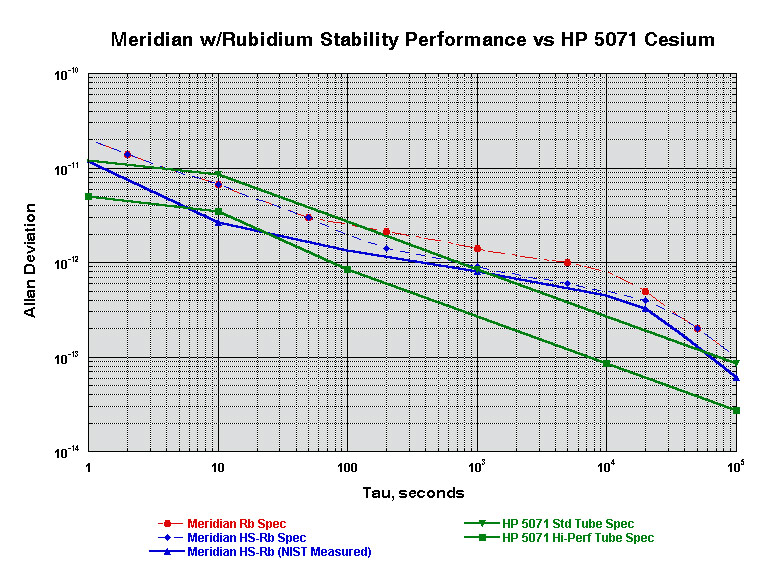
Cesium-based frequency standards are typically available in two performance grades depending upon the beam tube design: standard or high-performance. They continue to be large, expensive units with a well defined wear-out mechanism (cesium depletion) that periodically requires an expensive, beam tube replacement. The high-performance tube has about one-third of the life of the standard tube. In addition, prior to actual failure, anomalous frequency behaviors usually occur which are best detected by monitoring via a co-located GPS or Loran-C based frequency reference. Since modern, high-performance GPS-disciplined frequency standards like our Meridian II products (with rubidium) can match the long-term performance of the best standard tube cesium (at a much lower cost, while delivering superior short term performance and life expectancy) it's pretty easy to make a case for skipping cesium altogether in any application where an antenna may be installed. Click here to see a chart comparing the stability performance of a Meridian II GPS TimeBase vs. HP Cesium.
Short-Term and Long-Term Stability
Often the short-term behavior of an oscillator's frequency is as important as its long-term drift and sensitivity to environmental stresses. Short-term stability is measured in the frequency domain as phase noise, or in the time domain as 2-sample or Allan variance. Over observation intervals less than one second, crystal oscillators outperform all other oscillator types for this parameter. For this reason, the output of an atomic standard is taken directly from a crystal oscillator that is frequency locked to the atomic resonance frequency. The quartz oscillators manufactured by EndRun Technologies exhibit remarkable short term stability performance. Read about Low Phase Noise.
Beginning at observation intervals of 10 to 100 seconds, hydrogen masers take over and reign supreme until their frequency drift component reaches a level that gives the advantage to cesium. Rubidium offers superior short term stability to cesium for observation intervals less than about one day, which is why the GPS now uses rubidium standards in the satellites. The space environment actually enhances the performance of Rubidium frequency standards, and the system architecture and satellite orbit period allow the longer term instabilility to be measured and compensated effectively in real time.
Click here for details on the oscillators used by EndRun Technologies.