CDMA Timing
GPS-synchronized products require you to install a view-of-the-sky antenna.
CDMA-synchronized products work great with the antenna inside your building, just like your cell phone.
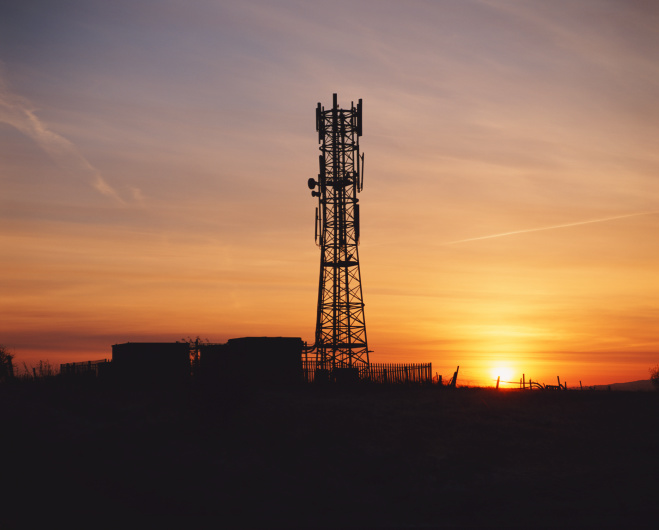
transmit the timing signal.
EndRun Technologies is the only company in the world to design and manufacture Network Time Servers that use CDMA cell phone signals as a timing reference. These products started selling in 2001 and have been very popular. But now, 20 years later, the CDMA cell phone system is near its end-of-life in the U.S. It has already been completely discontinued in most parts of the world. Therefore, we announced the phase-out of our Sonoma CDMA Network Time Server in December 2020.
How long will CDMA be Around?
CDMA-based time servers acquire a UTC time sync from CDMA base station signal broadcasts. CDMA service in the United States is currently provided by T-Mobile (via Sprint merger) and Verizon. The Verizon signal is acquired via the North American Cellular (NAC) channel set and T-Mobile via the North American PCS (NAP) channel set. If a CDMA base station is operational for phone service or M2M communications, it will broadcast the signals that are needed by our time servers.
T-Mobile has not publicly announced a sunset date for the Sprint CDMA 3G network. They have, however, messaged to some T-Mobile for Business customers that they intend to sunset Sprint CDMA 3G service on or around March 31, 2022 through May 31, 2022.
Verizon announced in March 2021 that the sunset date for CDMA service was extended for the last time to December 31, 2022.
CDMA service could degrade or become unavailable in some areas before the respective sunset dates as both providers focus on moving customers to their 4G and 5G networks and repurpose spectrum. Therefore EndRun advises customers that are currently operating CDMA time servers to start planning now to transition to a GPS based network time server. Alternatively, configuring time servers to operate as a Stratum 2 NTP server may be an option.
Reference Articles:
Verizon News Center (Mar 2021): 3G CDMA Network Shut off date set for December 31, 2022
TmoNews (Feb 2021): Report: T-Mobile 3G shutdown won’t happen until 2022
Android Police (Feb 2021): T-Mobile 3G shutdown reportedly delayed until 2022